The impact of increasing the White Land Fees
Feb 23, 2026
The Impact of Increasing White Land Fees to 10% in Selected Riyadh Districts on Real Estate Valuation and Financing
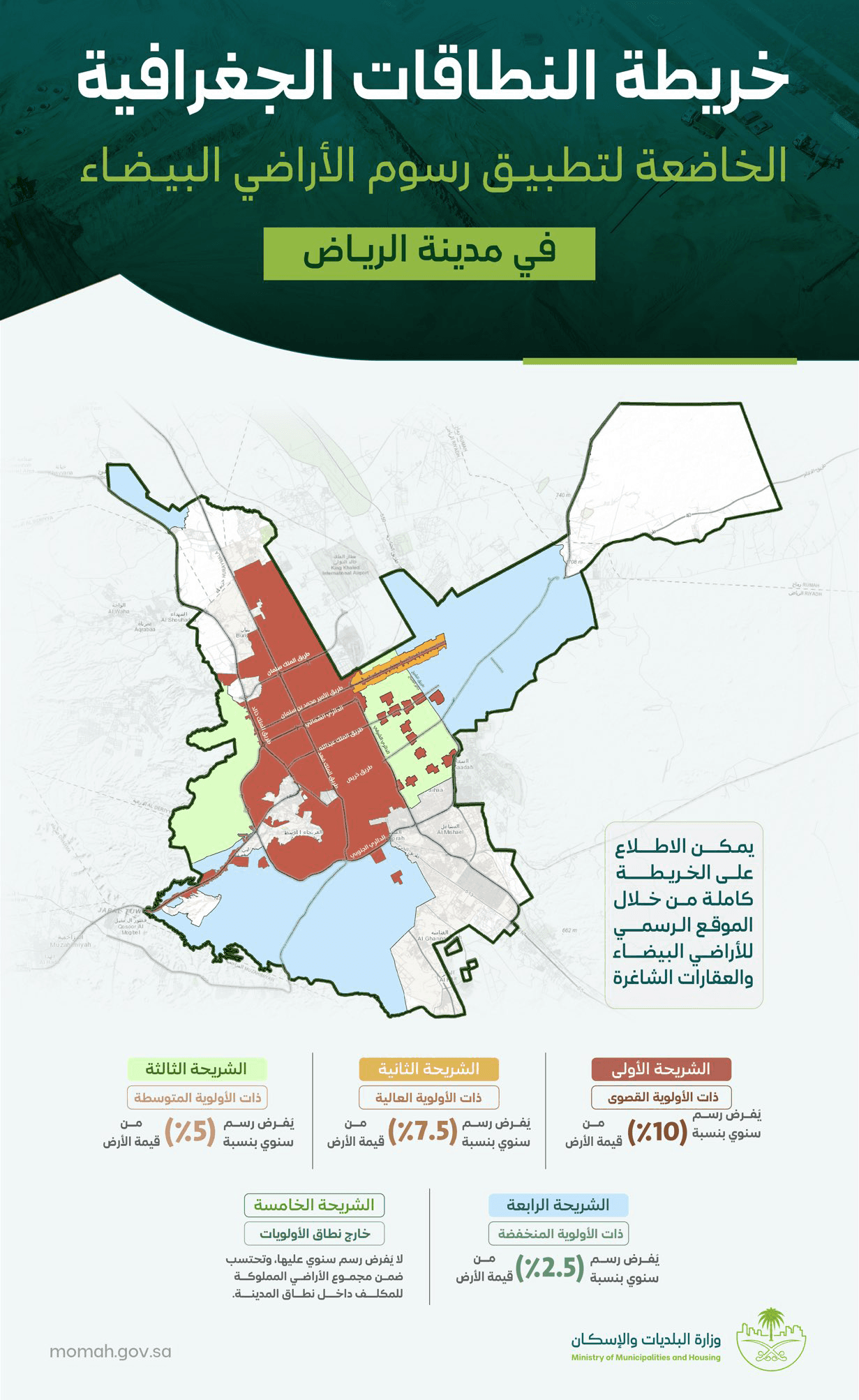
Following the announcement by the Ministry of Municipal and Rural Affairs and Housing regarding the implementation of a 10% White Land Fee on specific zones in Riyadh as part of the new phase of the system, several practical challenges have emerged for property valuers, financing institutions, and landowners. The most notable include:
A decline in recent transactions within certain affected districts.
A widening expectation gap between sellers and buyers.
Increased uncertainty in determining fair market value.
This development falls under the White Land Fees system, originally introduced through regulatory frameworks associated with the Royal Commission for Riyadh City and the former Ministry of Housing, aiming to stimulate development and increase real estate supply.
How to Professionally Address the Absence of Recent Transactions
1) Expanding the Geographic Scope of Comparables
When recent transactions within the same district are unavailable, reference may be made to comparable neighborhoods sharing similar characteristics, such as:
Zoning and permitted land use
Urban density
Infrastructure and service levels
Target demand segment
Clear and well-justified adjustment factors should be applied and documented within the valuation report.
2) Applying Multiple Valuation Approaches
Reliance solely on the sales comparison approach is insufficient. Reports should be strengthened through:
Residual Land Value Method, estimating land value based on projected feasibility after deducting:
Development costs
White Land Fees
Financing costs
Income Approach, where potential future returns can reasonably be projected.
Diversifying methodologies enhances the credibility of the final value, particularly before financing entities.
3) Analyzing the Economic Impact of the 10% Fee
Raising the fee to 10% alters the investment decision equation by:
Increasing pressure on owners to either develop or divest.
Repricing risk in financial models.
Potentially causing short-term liquidity slowdown while improving long-term supply dynamics.
Incorporating this economic analysis into the valuation report strengthens the defensibility of the assessed value despite limited transactions.
4) Leveraging Official and Regulatory Data
Valuations may be supported by referencing:
Approved geographic zoning maps
Fee classifications (10% – 7.5% – 5% – 2.5%)
Official data on land areas subject to fees
Building regulations issued via the Balady platform
These regulatory parameters provide an objective foundation for determining fair value.
5) Transparent Documentation of Assumptions
Every assumption used in the valuation must be:
Technically justified
Supported by market analysis
Explicitly disclosed in the report
Transparency reduces objections and enhances value acceptance by lenders and corporate stakeholders.
6) Utilizing Multiple Value Scenarios
Instead of presenting a single figure, it is advisable to provide a value range:
Conservative Scenario: Assumes continued weak demand.
Base Case Scenario: Reflects current market equilibrium.
Optimistic Scenario: Assumes accelerated development response to the fee.
This approach aligns with best practices in risk management within financial institutions.
7) Collecting Qualitative Market Intelligence
In the absence of quantitative transaction data, qualitative insights gain importance, including:
Interviews with local brokers
Engagement with developers
Analysis of purchase inquiries
Monitoring actual listing activity
8) Accurately Accounting for Development Costs and Risks
Valuation should properly reflect:
The impact of White Land Fees
Expected development timelines
Financing costs
Planning and infrastructure risks
All of these elements form part of the realistic market value of land.
Executive Summary
Despite limited transactions and subdued demand following the fee decision, professional valuers can maintain valuation accuracy by:
Diversifying valuation methodologies
Expanding the data base
Analyzing the economic impact of the fee
Applying multi-scenario valuation models
Ensuring transparent documentation of assumptions
At this stage, valuation is no longer merely a price comparison exercise; it is a comprehensive investment analysis reflecting regulatory changes, embedded risks, and forward-looking market expectations.
The impact of increasing the White Land Fees
Feb 23, 2026
The Impact of Increasing White Land Fees to 10% in Selected Riyadh Districts on Real Estate Valuation and Financing
Following the announcement by the Ministry of Municipal and Rural Affairs and Housing regarding the implementation of a 10% White Land Fee on specific zones in Riyadh as part of the new phase of the system, several practical challenges have emerged for property valuers, financing institutions, and landowners. The most notable include:
A decline in recent transactions within certain affected districts.
A widening expectation gap between sellers and buyers.
Increased uncertainty in determining fair market value.
This development falls under the White Land Fees system, originally introduced through regulatory frameworks associated with the Royal Commission for Riyadh City and the former Ministry of Housing, aiming to stimulate development and increase real estate supply.
How to Professionally Address the Absence of Recent Transactions
1) Expanding the Geographic Scope of Comparables
When recent transactions within the same district are unavailable, reference may be made to comparable neighborhoods sharing similar characteristics, such as:
Zoning and permitted land use
Urban density
Infrastructure and service levels
Target demand segment
Clear and well-justified adjustment factors should be applied and documented within the valuation report.
2) Applying Multiple Valuation Approaches
Reliance solely on the sales comparison approach is insufficient. Reports should be strengthened through:
Residual Land Value Method, estimating land value based on projected feasibility after deducting:
Development costs
White Land Fees
Financing costs
Income Approach, where potential future returns can reasonably be projected.
Diversifying methodologies enhances the credibility of the final value, particularly before financing entities.
3) Analyzing the Economic Impact of the 10% Fee
Raising the fee to 10% alters the investment decision equation by:
Increasing pressure on owners to either develop or divest.
Repricing risk in financial models.
Potentially causing short-term liquidity slowdown while improving long-term supply dynamics.
Incorporating this economic analysis into the valuation report strengthens the defensibility of the assessed value despite limited transactions.
4) Leveraging Official and Regulatory Data
Valuations may be supported by referencing:
Approved geographic zoning maps
Fee classifications (10% – 7.5% – 5% – 2.5%)
Official data on land areas subject to fees
Building regulations issued via the Balady platform
These regulatory parameters provide an objective foundation for determining fair value.
5) Transparent Documentation of Assumptions
Every assumption used in the valuation must be:
Technically justified
Supported by market analysis
Explicitly disclosed in the report
Transparency reduces objections and enhances value acceptance by lenders and corporate stakeholders.
6) Utilizing Multiple Value Scenarios
Instead of presenting a single figure, it is advisable to provide a value range:
Conservative Scenario: Assumes continued weak demand.
Base Case Scenario: Reflects current market equilibrium.
Optimistic Scenario: Assumes accelerated development response to the fee.
This approach aligns with best practices in risk management within financial institutions.
7) Collecting Qualitative Market Intelligence
In the absence of quantitative transaction data, qualitative insights gain importance, including:
Interviews with local brokers
Engagement with developers
Analysis of purchase inquiries
Monitoring actual listing activity
8) Accurately Accounting for Development Costs and Risks
Valuation should properly reflect:
The impact of White Land Fees
Expected development timelines
Financing costs
Planning and infrastructure risks
All of these elements form part of the realistic market value of land.
Executive Summary
Despite limited transactions and subdued demand following the fee decision, professional valuers can maintain valuation accuracy by:
Diversifying valuation methodologies
Expanding the data base
Analyzing the economic impact of the fee
Applying multi-scenario valuation models
Ensuring transparent documentation of assumptions
At this stage, valuation is no longer merely a price comparison exercise; it is a comprehensive investment analysis reflecting regulatory changes, embedded risks, and forward-looking market expectations.
The impact of increasing the White Land Fees
Feb 23, 2026
The Impact of Increasing White Land Fees to 10% in Selected Riyadh Districts on Real Estate Valuation and Financing
Following the announcement by the Ministry of Municipal and Rural Affairs and Housing regarding the implementation of a 10% White Land Fee on specific zones in Riyadh as part of the new phase of the system, several practical challenges have emerged for property valuers, financing institutions, and landowners. The most notable include:
A decline in recent transactions within certain affected districts.
A widening expectation gap between sellers and buyers.
Increased uncertainty in determining fair market value.
This development falls under the White Land Fees system, originally introduced through regulatory frameworks associated with the Royal Commission for Riyadh City and the former Ministry of Housing, aiming to stimulate development and increase real estate supply.
How to Professionally Address the Absence of Recent Transactions
1) Expanding the Geographic Scope of Comparables
When recent transactions within the same district are unavailable, reference may be made to comparable neighborhoods sharing similar characteristics, such as:
Zoning and permitted land use
Urban density
Infrastructure and service levels
Target demand segment
Clear and well-justified adjustment factors should be applied and documented within the valuation report.
2) Applying Multiple Valuation Approaches
Reliance solely on the sales comparison approach is insufficient. Reports should be strengthened through:
Residual Land Value Method, estimating land value based on projected feasibility after deducting:
Development costs
White Land Fees
Financing costs
Income Approach, where potential future returns can reasonably be projected.
Diversifying methodologies enhances the credibility of the final value, particularly before financing entities.
3) Analyzing the Economic Impact of the 10% Fee
Raising the fee to 10% alters the investment decision equation by:
Increasing pressure on owners to either develop or divest.
Repricing risk in financial models.
Potentially causing short-term liquidity slowdown while improving long-term supply dynamics.
Incorporating this economic analysis into the valuation report strengthens the defensibility of the assessed value despite limited transactions.
4) Leveraging Official and Regulatory Data
Valuations may be supported by referencing:
Approved geographic zoning maps
Fee classifications (10% – 7.5% – 5% – 2.5%)
Official data on land areas subject to fees
Building regulations issued via the Balady platform
These regulatory parameters provide an objective foundation for determining fair value.
5) Transparent Documentation of Assumptions
Every assumption used in the valuation must be:
Technically justified
Supported by market analysis
Explicitly disclosed in the report
Transparency reduces objections and enhances value acceptance by lenders and corporate stakeholders.
6) Utilizing Multiple Value Scenarios
Instead of presenting a single figure, it is advisable to provide a value range:
Conservative Scenario: Assumes continued weak demand.
Base Case Scenario: Reflects current market equilibrium.
Optimistic Scenario: Assumes accelerated development response to the fee.
This approach aligns with best practices in risk management within financial institutions.
7) Collecting Qualitative Market Intelligence
In the absence of quantitative transaction data, qualitative insights gain importance, including:
Interviews with local brokers
Engagement with developers
Analysis of purchase inquiries
Monitoring actual listing activity
8) Accurately Accounting for Development Costs and Risks
Valuation should properly reflect:
The impact of White Land Fees
Expected development timelines
Financing costs
Planning and infrastructure risks
All of these elements form part of the realistic market value of land.
Executive Summary
Despite limited transactions and subdued demand following the fee decision, professional valuers can maintain valuation accuracy by:
Diversifying valuation methodologies
Expanding the data base
Analyzing the economic impact of the fee
Applying multi-scenario valuation models
Ensuring transparent documentation of assumptions
At this stage, valuation is no longer merely a price comparison exercise; it is a comprehensive investment analysis reflecting regulatory changes, embedded risks, and forward-looking market expectations.
Recent Articles
Recent Articles



Join SIMA'S
Newsletter Today!
Stay ahead in the property market.
Join our newsletter and gain access to exclusive market insights, expert consultation tips, and tailored real estate opportunities.
Join SIMA'S
Newsletter Today!
Stay ahead in the property market.
Join our newsletter and gain access to exclusive market insights, expert consultation tips, and tailored real estate opportunities.
Join SIMA'S
Newsletter Today!
Stay ahead in the property market.
Join our newsletter and gain access to exclusive market insights, expert consultation tips, and tailored real estate opportunities.